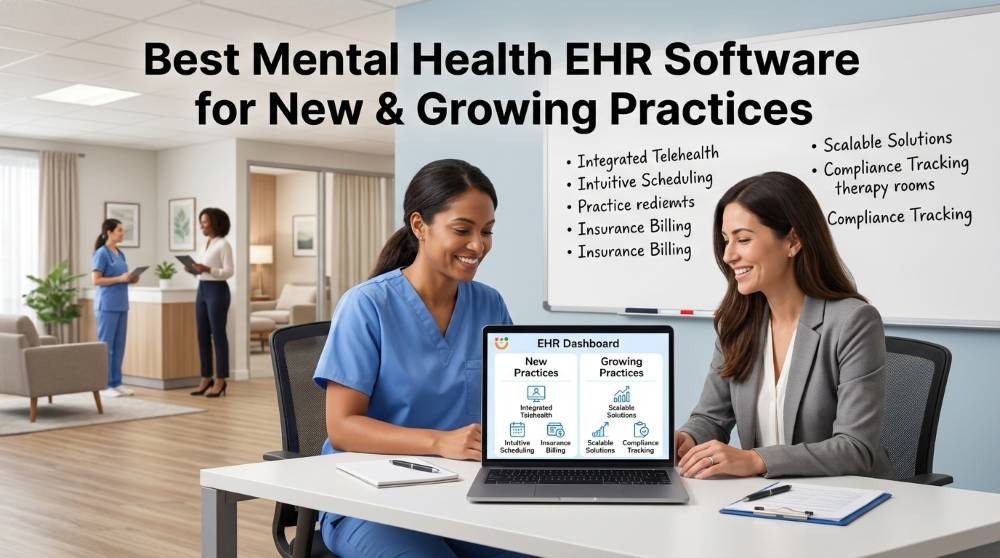
Starting or growing a mental health practice is exciting but the administrative side can become overwhelming very quickly. Between scheduling appointments, documenting sessions, managing patient records, checking insurance benefits, submitting claims, collecting payments, communicating with clients, and staying organized, providers can spend far too much time working on the practice instead of with the people they serve.
That is where the right mental health EHR software can make a meaningful difference.
For a new therapist, psychologist, counselor, psychiatrist, LCSW, PMHNP, or behavioral health practice, an EHR is much more than a digital filing cabinet. The right system can become the operational foundation of the practice connecting clinical documentation, scheduling, billing, telehealth, client communication, and practice management in one place.
But there is no single EHR that is perfect for every mental health provider.
A solo therapist opening a private practice may need simplicity and affordability. A growing group practice may care more about staff management, billing workflows, reporting, and scalability. A psychiatric practice may prioritize e-prescribing and medication management. A primarily insurance-based practice may need strong eligibility verification and claims tools.
So, what is the best mental health EHR software for a new or growing practice?
The answer depends on what you need today—and where you expect your practice to be two or three years from now.
What Is Mental Health EHR Software?
Mental health EHR software is a specialized electronic health record and practice-management system designed to help behavioral health professionals manage clinical and administrative workflows.
Instead of keeping information across spreadsheets, paper files, email, separate scheduling systems, and standalone billing applications, an EHR can bring many of these processes together.
Typical mental health EHR features include:
- Patient/client records
- Intake forms
- Clinical documentation
- Treatment plans
- Progress notes
- Appointment scheduling
- Appointment reminders
- Client portals
- Telehealth
- Secure messaging
- Insurance eligibility verification
- Claims management
- Billing and payments
- Reporting and analytics
- Electronic prescribing for eligible providers
- Staff and provider management
- Mobile access
- Practice growth tools
Modern platforms increasingly include automation and AI-assisted documentation as well.
For a new practice, this can mean less administrative work. For an established practice, it can mean better consistency, improved visibility into operations, and a workflow that can scale as the number of providers and clients increases.
Why New Mental Health Practices Need the Right EHR
When a practice has only one provider and a handful of clients, it may be tempting to choose software based solely on price.
That can be a mistake.
The software you choose during your first few months can become deeply integrated into your practice. Your client records, documentation templates, scheduling processes, billing workflows, and staff routines may all eventually depend on it.
Switching systems later can take considerable time and effort.
A better approach is to ask:
“What will my practice need when I have 50, 100, or 500 active clients?”
For a new provider, the ideal EHR should be:
Easy to learn
You should not need weeks of technical training before you can document a session.
Designed for behavioral health
Mental health documentation has different requirements from many other healthcare specialties. Templates should support your clinical workflow rather than force you into a generic medical workflow.
Flexible
Your practice may start with one clinician and eventually add therapists, psychologists, psychiatric providers, billers, administrative staff, or multiple locations.
Billing-friendly
If you accept insurance, claims and eligibility workflows can become a major part of your daily operations.
Patient-friendly
A client portal, online forms, appointment requests, reminders, secure communication, and telehealth can make the experience smoother for both provider and client.
Scalable
The EHR should grow with your business instead of becoming a limitation.
Best Mental Health EHR Software Options
There are several established platforms worth considering. Your best choice depends on your practice model, specialty, budget, and growth plans.
Below are some of the most relevant options for new and growing mental health practices.
1. SimplePractice — Best for User-Friendly Private Practices
SimplePractice is one of the most recognizable platforms for therapists, psychologists, counselors, and other behavioral health professionals.
It focuses heavily on creating a streamlined experience for independent practitioners and small group practices.
Its features include scheduling, documentation, billing, insurance tools, client portals, telehealth, secure messaging, appointment reminders, electronic forms, analytics, and other practice-management capabilities.
SimplePractice currently lists three standard plans starting at $49/month for Starter, $79/month for Essential, and $99/month for Plus, although specific features and add-on costs vary by plan.
Why new practices may like it
SimplePractice can be particularly attractive to a clinician who wants to avoid stitching several different systems together.
A new therapist may be able to manage:
- Scheduling
- Client intake
- Documentation
- Payments
- Insurance workflows
- Telehealth
- Secure communication
- Client portal
- Practice reporting
from one environment.
The platform also offers features aimed at practice growth, including online appointment requests, analytics, team management, and marketing-related tools.
Best fit
Solo therapists, psychologists, counselors, and small growing practices that prioritize usability and an all-in-one workflow.
2. TherapyNotes Strong Choice for Documentation and Insurance-Based Practices
TherapyNotes is another well-established option specifically designed around behavioral health documentation and practice management.
One of its major strengths is its structured clinical documentation.
TherapyNotes provides templates designed for behavioral health professionals, including SOAP, DAP, and BIRP-style documentation. Providers can also customize progress-note templates.
That can be particularly valuable for clinicians who want documentation to be structured without spending excessive time formatting every note.
TherapyNotes also includes scheduling, secure messaging, client portals, basic telehealth, file storage, and other practice-management features.
Optional services include premium telehealth, e-prescribing, AI documentation tools, and medical billing services.
Why it stands out
For an insurance-based mental health practice, documentation and billing workflows can be just as important as the clinical interface.
TherapyNotes connects appointments and documentation workflows so that providers can move from scheduled services into the appropriate documentation process.
Best fit
Therapists and small behavioral health practices that prioritize clinical documentation and insurance-related workflows.
3. Valant Strong Option for Growing Behavioral Health Organizations
Valant takes a more specialized behavioral-health approach and can be worth considering for practices that are moving beyond a simple solo-practice model.
Valant describes its platform as supporting documentation, scheduling, treatment planning, data and outcome tracking, and workflows for both prescribing and non-prescribing professionals.
This makes it potentially relevant for larger behavioral health organizations, psychiatric practices, and multi-provider environments.
Why growing practices should consider it
As a practice grows, the question changes from:
“Can I document my sessions?”
to:
“Can my entire organization operate efficiently?”
A larger practice may need:
- Multiple providers
- Role-based workflows
- Outcome measurement
- Reporting
- Complex scheduling
- Treatment planning
- Medication-related workflows
- More sophisticated operational management
Valant is designed with behavioral health organizations in mind.
Best fit
Growing behavioral health organizations, psychiatry practices, and practices requiring more specialized behavioral-health functionality.
4. ICANotes Designed Around Behavioral Health Documentation
ICANotes is another platform frequently considered by mental health and behavioral health providers.
Its approach is heavily focused on simplifying clinical documentation.
This can be particularly useful for providers who find traditional EHR documentation too time-consuming.
For clinicians, documentation is one of those unavoidable parts of practice. You can have an excellent clinical relationship with your client, but the session still needs to be documented appropriately.
A documentation-focused EHR can help standardize that process.
Best fit
Mental health providers and practices that place a strong emphasis on efficient clinical documentation.
5. TheraNest / Ensora Mental Health — Worth Considering for Growing Practices
Ensora Health offers behavioral health practice-management solutions associated with the TheraNest platform.
It may be worth evaluating for practices that want to manage multiple clinicians and administrative processes within a behavioral-health-focused environment.
As with any EHR, however, practices should evaluate the current product, support experience, integrations, pricing, and specific workflows before making a decision.
Mental Health EHR Comparison
| EHR | Best For | Major Strength |
|---|---|---|
| SimplePractice | Solo & small practices | Ease of use and all-in-one practice management |
| TherapyNotes | Therapy & insurance-based practices | Documentation and billing workflows |
| Valant | Growing behavioral health organizations | Specialized behavioral health workflows |
| ICANotes | Documentation-heavy practices | Clinical documentation |
| Ensora/ TherаNest | Growing practices | Practice management and behavioral health workflows |
These aren’t rankings that mean one system is universally “better.” The right choice depends on your practice model.
Recent 2026 comparisons similarly distinguish between general-purpose platforms for solo/small practices and more specialized systems for psychiatry or larger behavioral health organizations.
What Features Should a New Mental Health Practice Look For?
Choosing an EHR based on a pretty interface is not enough.
Before signing up, look carefully at the following features.
1. Clinical Documentation
Documentation is at the center of behavioral healthcare.
Look for:
- Customizable templates
- Progress notes
- Treatment plans
- Assessments
- Diagnoses
- Electronic signatures
- Historical note access
- Document storage
- Audit-friendly workflows
The goal isn’t simply to “write notes faster.”
The goal is to create a consistent documentation workflow that supports quality care and reduces administrative friction.
2. Scheduling
A growing practice can quickly become difficult to manage using a basic calendar.
Look for:
- Recurring appointments
- Provider calendars
- Appointment reminders
- Online booking
- Cancellation management
- Waitlists
- Multiple provider scheduling
- Calendar synchronization
A good scheduling system can also reduce the number of administrative calls your office receives.
3. Client Portal
A modern mental health practice should make it easy for clients to interact with the practice.
A client portal may allow clients to:
- Complete intake paperwork
- Review documents
- Make payments
- Request appointments
- Communicate securely
- Attend telehealth sessions
- Update demographic or insurance information
This creates a more professional client experience from the first interaction.
4. Telehealth
Virtual behavioral healthcare has become an important part of many practices.
Your EHR should make telehealth simple rather than forcing you to use a separate system whenever possible.
For example, SimplePractice offers integrated telehealth functionality, including features such as waiting rooms and screen sharing.
When evaluating telehealth, consider:
- Ease of joining sessions
- Client experience
- Waiting rooms
- Screen sharing
- Group sessions
- Audio/video quality
- Security
- Documentation integration
5. Insurance and Billing
This is one of the most important areas for a growing practice.
A beautiful EHR won’t help much if claims are consistently rejected.
Look for:
- Eligibility verification
- Electronic claims
- Claim tracking
- ERA/EOB workflows
- Patient statements
- Online payments
- Outstanding balance reporting
- Denial management
- Superbills
- Insurance reports
Also look carefully at what is included in the monthly subscription versus what is charged separately.
For example, SimplePractice’s current plans differ in included claim volumes and insurance features.
6. E-Prescribing
If you operate a psychiatric practice or provide medication management, e-prescribing can become an essential consideration.
Not every mental health provider needs this functionality.
But psychiatrists, psychiatric nurse practitioners, and other eligible prescribing professionals should evaluate:
- E-prescribing
- Controlled-substance workflows where applicable
- Medication lists
- Pharmacy connectivity
- Refill workflows
- Medication history
For example, SimplePractice offers ePrescribe as an add-on, while TherapyNotes also offers integrated e-prescribing as an optional feature.
7. AI-Assisted Documentation
AI is becoming increasingly relevant to mental health EHR software.
The attraction is obvious:
Less time typing. More time with clients.
Some platforms now offer AI-assisted note generation or documentation tools.
But providers should not choose an EHR simply because it has an AI button.
Ask:
- How does the AI create drafts?
- Can clinicians review and edit everything?
- How is sensitive information handled?
- Is the feature included or an extra cost?
- Does it fit your documentation workflow?
- Does it actually save time?
For example, SimplePractice currently offers its Note Taker as an add-on, while TherapyNotes offers TherapyFuel as an optional AI documentation product.
EHR Software Should Support Practice Growth—not Create More Work
One of the biggest mistakes new providers make is choosing software based solely on the lowest monthly price.
Suppose you start with one therapist.
Then you add another.
Then another.
Then you hire an office manager.
Then your practice begins accepting more insurance plans.
Suddenly, you need:
- Multiple user accounts
- Role permissions
- Provider scheduling
- Better billing reports
- Insurance management
- Revenue tracking
- Client waitlists
- Operational reporting
- Staff workflows
The software that was perfect for a solo provider may suddenly feel restrictive.
That is why scalability should be part of your EHR decision from day one.
EHR + Credentialing + Billing: The Bigger Picture
An EHR is only one part of running a successful mental health practice.
For many new providers, the bigger challenge is getting the practice operational.
That may involve:
Provider credentialing → Payer enrollment → EHR setup → Scheduling → Documentation → Claims → Payment → Reporting
If one part of this process breaks down, revenue can suffer.
For example, having excellent EHR software won’t solve the problem if your provider isn’t properly enrolled with the payer.
Likewise, getting credentialed won’t automatically guarantee clean claims if your payer information, provider data, CPT codes, documentation, or billing workflows are incorrect.
This is why growing practices often benefit from combining good technology with experienced provider enrollment, credentialing, and medical billing support.
How to Choose the Best EHR for Your Practice
Before purchasing software, ask yourself these questions.
Are you a solo provider?
Prioritize:
- Affordability
- Ease of use
- Documentation
- Scheduling
- Client portal
- Telehealth
- Basic billing
SimplePractice and TherapyNotes are worth comparing.
Are you primarily insurance-based?
Put more emphasis on:
- Eligibility verification
- Claims
- Billing
- ERA/EOB workflows
- Denial management
- Reporting
TherapyNotes and other billing-oriented systems may deserve a closer look.
Are you a psychiatrist or prescribing provider?
Focus on:
- E-prescribing
- Medication management
- Clinical documentation
- Outcome measurement
- Psychiatric workflows
Platforms such as Valant and ICANotes may be worth evaluating alongside other options.
Are you building a group practice?
Think beyond today’s needs.
Look at:
- Multiple providers
- Permissions
- Reporting
- Scheduling
- Billing
- Staff workflows
- Scalability
- Integrations
Don’t Choose Your EHR by Price Alone
A $30/month system isn’t necessarily cheaper than a $100/month system.
Why?
Because the monthly subscription is only one part of the total cost.
You should also consider:
- Claims fees
- Telehealth fees
- E-prescribing fees
- AI documentation fees
- Payment processing
- Eligibility checks
- Additional users
- Setup fees
- Training
- Data migration
- Billing services
For example, current SimplePractice pricing ranges from $49 to $99/month depending on the plan, with some features offered separately.
TherapyNotes similarly provides optional services and add-ons beyond its core subscription.
So don’t ask:
“Which EHR has the cheapest monthly price?”
Ask:
“What will my complete monthly technology and administrative cost be?”
That is a much better comparison.
Final Recommendation: What Is the Best Mental Health EHR?
There isn’t one universal winner.
For many new solo mental health practices, SimplePractice is an attractive option because it combines scheduling, documentation, client communication, billing, telehealth, and practice-management tools in one platform.
For practices that place greater emphasis on structured behavioral-health documentation and insurance workflows, TherapyNotes deserves serious consideration.
For larger or more specialized behavioral health organizations, Valant and other enterprise-oriented platforms may be better suited to more complex operational requirements.
The best EHR is ultimately the one that fits your specialty, workflow, payer mix, provider count, budget, and growth strategy.
Build Your Mental Health Practice on the Right Foundation
Choosing EHR software is an important decision but software alone doesn’t build a successful practice.
A growing mental health practice needs the right combination of:
Clinical workflow + EHR + Credentialing + Payer Enrollment + Billing + Revenue Cycle Management + Compliance + Practice Growth
If you’re a new provider, don’t wait until your caseload is full to organize these systems.
Start with a workflow that can grow with you.
And if you’re an established provider whose current EHR, billing, credentialing, or administrative process feels increasingly difficult to manage, it may be time to evaluate whether your technology and support systems are still appropriate for the size of your practice.
The goal isn’t simply to find an EHR.
The goal is to build a mental health practice where technology handles the repetitive administrative work—so providers can spend more of their time doing what matters most: providing excellent care to their clients.
A Smart Next Step for New & Growing Practices
If your mental health practice is expanding, consider reviewing your entire workflow—not just your EHR.
A strong setup can look like:
1. Provider Credentialing
Get your clinicians properly credentialed.
2. Payer Enrollment
Enroll providers with the insurance networks relevant to your market.
3. EHR Implementation
Configure documentation, scheduling, forms, telehealth, and client communication.
4. Billing Setup
Establish accurate payer, CPT, provider, and billing workflows.
5. Claims & A/R Management
Monitor claims, denials, payments, and outstanding balances.
6. Practice Growth
Use reporting and operational data to understand where your practice is growing—and where revenue may be getting lost.
For a company such as Hillcrest Medical Billing, this creates an opportunity to position credentialing, enrollment, billing, and EHR support as part of a broader solution for mental health providers rather than presenting each service as an isolated task.