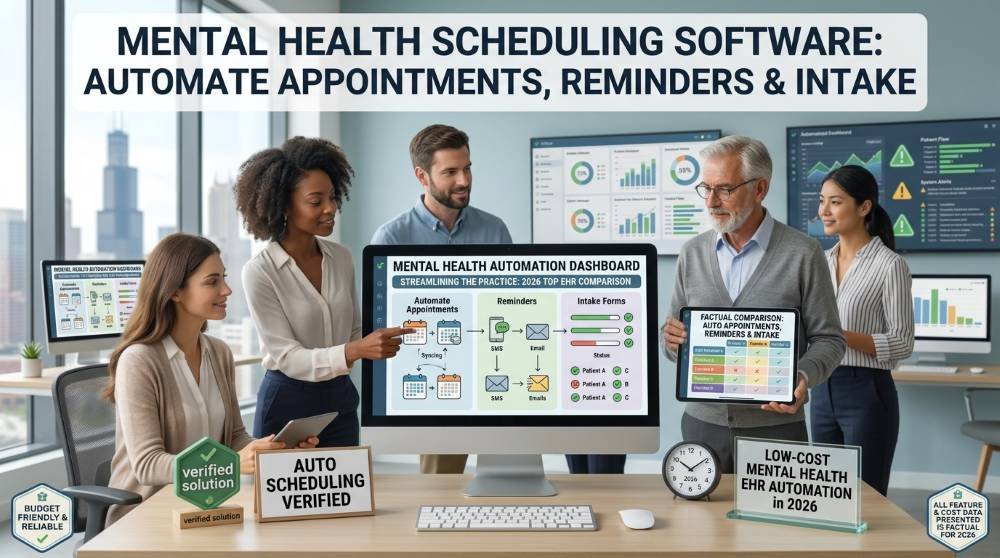
Running a mental health practice is about much more than sitting down with clients for a therapy session. Behind every successful appointment is a long list of administrative tasks—checking availability, answering scheduling calls, sending reminders, collecting intake forms, handling cancellations, and keeping your calendar organized.
For a growing practice, these tasks can quickly become overwhelming.
That is where mental health scheduling software can make a real difference.
Modern therapy scheduling software allows therapists, psychologists, psychiatrists, counselors, and behavioral health practices to automate appointment booking, client reminders, intake forms, cancellations, rescheduling, and other routine administrative work. Instead of spending valuable time managing a calendar, providers can spend more time doing what matters most: supporting their clients.
In 2026, many practices are also looking beyond a basic calendar. They want scheduling software that can work alongside an EHR or mental health practice management software, support secure client communication, offer online booking, and make the entire client experience easier.
What Is Mental Health Scheduling Software?
Mental health scheduling software is a digital solution designed to help behavioral health professionals manage appointments and practice schedules more efficiently.
Unlike a basic calendar, specialized therapy appointment scheduling software can connect scheduling with other parts of the practice workflow.
Depending on the platform, features may include:
- Online appointment booking
- Client self-scheduling
- Automated appointment reminders
- SMS and email notifications
- Online intake forms
- Consent forms
- Appointment confirmations
- Cancellation and rescheduling
- Recurring appointments
- Waitlist management
- Calendar synchronization
- Telehealth scheduling
- Payment collection
- Client portals
- EHR integration
- Staff and provider scheduling
For example, mental health-focused platforms such as Sessions Health combine scheduling with documentation, billing, telehealth, client portals, and other practice-management functions.
The goal is simple: less administrative work and a smoother experience for both providers and clients.
Why Therapists Are Moving to Online Appointment Scheduling
Imagine this:
A new client finds your practice online at 9:30 p.m. Instead of waiting until the next morning to call, they click your online therapy scheduling link, view your available appointment times, select a suitable slot, complete the required intake information, and receive an appointment confirmation.
Your calendar updates automatically.
Your client receives a reminder before the appointment.
You receive the information you need to prepare.
That is the difference between manually managing appointments and using automated scheduling software for therapists.
Online scheduling gives clients more flexibility while reducing the back-and-forth communication that often comes with traditional appointment booking.
For busy therapists, this can be particularly valuable because recurring appointments, cancellations, and schedule changes can otherwise consume a surprising amount of time.
Automated Appointment Reminders Help Reduce No-Shows
One of the biggest reasons practices invest in therapy scheduling software is to manage missed appointments.
A client may genuinely forget an appointment. They may have a busy workday, family responsibilities, or simply lose track of the date.
Manually calling every client is not practical.
With automated appointment reminders, the software can send scheduled notifications through email or text, depending on the platform and configuration.
A typical workflow might look like:
Appointment booked → Confirmation sent → Reminder sent → Client attends → Follow-up appointment scheduled
Some mental health scheduling platforms allow clients to choose their preferred reminder method, such as email or text. Sessions Health, for example, supports automated email and text appointment reminders.
The result is a more consistent reminder process without requiring your front desk—or you—to remember every appointment manually.
Why automated reminders matter
Automated reminders can help:
- Reduce forgotten appointments
- Improve schedule visibility
- Make cancellations easier to manage
- Give clients an opportunity to reschedule
- Reduce administrative calls
- Keep recurring therapy appointments organized
For a solo therapist, even a small reduction in missed appointments can make a meaningful difference to the practice.
Digital Intake Forms Before the First Session
Scheduling is only one part of the client onboarding process.
Once someone books an appointment, you may still need to collect:
- Contact information
- Demographic information
- Insurance details
- Practice policies
- Consent forms
- Telehealth agreements
- Relevant history
- Screening questionnaires
- Other required paperwork
This is where online intake forms for therapists become especially useful.
Instead of sending multiple emails or asking a new client to complete paperwork in the waiting room, scheduling software can connect intake forms to the appointment workflow.
Some platforms allow clients to complete forms before their first session and use electronic signatures for consent documents.
This creates a much smoother onboarding experience.
More importantly, it gives the provider an opportunity to review the information before meeting the client.
A better client experience
Instead of:
Book → Wait → Receive paperwork → Print → Complete → Return
you can create:
Book → Complete secure intake → Sign required forms → Receive reminders → Attend session
Simple changes like this can make a private practice feel more organized and professional from the very first interaction.
Client Self-Scheduling Gives Your Practice More Flexibility
Many therapists still spend part of their day responding to messages such as:
“Do you have anything available Tuesday afternoon?”
Then:
“That time doesn’t work. What about Wednesday?”
Then:
“Can you send me your available times?”
This back-and-forth may seem small, but multiplied across dozens of clients, it becomes a significant administrative burden.
Online booking software for therapists allows clients to see the availability you choose to make public and select an appointment themselves.
You remain in control of your schedule.
You can establish:
- Available days
- Working hours
- Appointment duration
- Buffer times
- New-client appointment types
- Existing-client appointments
- Telehealth sessions
- In-person sessions
- Recurring appointments
This makes scheduling more predictable while giving clients greater convenience.
Recurring Appointments Are Especially Important for Therapy Practices
Mental health care often involves ongoing appointments rather than one-time visits.
A client may meet with a therapist:
- Weekly
- Every two weeks
- Monthly
- For a defined treatment period
That makes recurring appointment scheduling an important feature for therapy practices.
Instead of manually creating every appointment, providers can establish a recurring schedule where supported by the software.
This can help keep calendars organized and reduce the risk of accidentally missing a future appointment.
It also creates a more consistent experience for clients who want to maintain their regular therapy routine.
Managing Cancellations and Rescheduling Without the Chaos
Cancellations are unavoidable in private practice.
The challenge is what happens afterward.
A client cancels.
You need to update the calendar.
Then you may need to contact someone on your waiting list.
Then you need to find another suitable time.
Then you have to update the new appointment.
Mental health practice scheduling software can simplify much of this process.
Depending on the platform, clients may be able to cancel or reschedule online according to the rules established by the practice.
Some systems also provide waitlist functionality, allowing practices to manage openings more efficiently. Modern practice-management platforms commonly combine online booking, scheduling, reminders, and waitlist capabilities.
For a growing practice, that can turn an empty appointment slot into an opportunity rather than lost time.
What Features Should You Look for in Therapy Scheduling Software?
Not every scheduling platform is designed for mental health care.
A generic calendar may be enough for basic appointments, but therapists often need more specialized capabilities.
1. Online Appointment Booking
Clients should be able to book available sessions without constantly contacting the office.
2. Automated SMS and Email Reminders
Look for customizable reminders that can be sent automatically before appointments.
3. Digital Intake Forms
The ability to collect required information before an appointment can simplify onboarding.
4. Client Portal
A secure client portal can give clients one place to manage appointments, forms, messages, and other practice-related tasks.
5. Recurring Scheduling
This is especially helpful for weekly and biweekly therapy sessions.
6. Cancellation and Rescheduling
Clients should have an easy way to make schedule changes within your practice policies.
7. EHR Integration
If you already use an EHR for mental health, scheduling software should ideally integrate with your existing workflow rather than create another disconnected system.
8. Telehealth
For practices providing virtual therapy, integrated telehealth scheduling can reduce the number of separate tools required.
9. Privacy and Security
This is critical.
Mental health practices handle highly sensitive information. Before choosing a platform, carefully review its security features, privacy terms, and whether it provides the agreements and safeguards required for your specific use case.
For U.S. practices handling protected health information, verify whether the vendor will enter into a Business Associate Agreement (BAA) where required. A scheduling platform should not be treated as HIPAA-ready simply because it advertises itself as a scheduling tool.
Mental Health Scheduling Software vs. a Basic Calendar
A basic calendar can tell you when an appointment is scheduled.
Mental health scheduling software can help manage what happens before, during, and around that appointment.
| Basic Calendar | Mental Health Scheduling Software |
|---|---|
| Appointment dates | Online client booking |
| Manual updates | Automated scheduling |
| Basic notifications | SMS/email reminders |
| Limited client interaction | Client portal |
| Separate intake process | Digital intake forms |
| Manual recurring appointments | Recurring scheduling |
| Limited workflow | EHR/practice-management integration |
| Separate telehealth tools | Telehealth options on some platforms |
This is why choosing the cheapest calendar isn’t always the same as choosing the most cost-effective solution.
The right question is not simply:
“How much does the software cost?”
Instead, ask:
“How much administrative work can this software remove from my practice?”
Popular Mental Health Scheduling Software Options
There are several categories of tools available today.
For practices wanting an all-in-one solution, platforms such as SimplePractice and TherapyNotes are commonly considered because scheduling can be combined with clinical documentation and practice-management workflows. Current 2026 comparisons also identify TherapyNotes, SimplePractice, Jane, Sessions Health, and Acuity among commonly evaluated options for therapists.
Sessions Health is another option focused specifically on mental health professionals, with scheduling integrated alongside documentation, billing, telehealth, and client communication.
For practices that primarily need scheduling rather than a complete EHR, Acuity Scheduling can be considered as a standalone scheduling option. The important distinction is whether you need just appointment scheduling or a complete mental health practice management system.
How Much Does Mental Health Scheduling Software Cost?
Pricing varies significantly.
Basic scheduling platforms may offer free or low-cost plans, while complete mental health EHR software can cost considerably more because it includes features such as:
- Clinical documentation
- Billing
- Insurance claims
- Telehealth
- Client portals
- Electronic intake
- Scheduling
- Reporting
Recent 2026 comparisons show a wide range between standalone scheduling products and full EHR platforms.
For a new therapist, a simple scheduling solution may be sufficient.
For an established practice with insurance billing, multiple clinicians, clinical documentation, and telehealth, investing in an integrated EHR may make more sense.
Don’t pay for features you don’t need—but don’t choose a cheap scheduler that creates more administrative work later.
How Scheduling Automation Helps New Therapists Grow
Starting a private practice can feel exciting and overwhelming at the same time.
You are trying to attract clients, build referral relationships, manage your calendar, complete documentation, handle billing, and provide excellent care.
The last thing you need is to spend hours every week answering basic scheduling questions.
Automated therapy scheduling software can give a new provider a more professional workflow from day one.
A new therapist can:
- Create a professional booking page.
- Define available appointment times.
- Allow clients to request or book appointments.
- Send automated confirmations.
- Collect digital intake information.
- Send appointment reminders.
- Manage cancellations.
- Keep recurring appointments organized.
- Connect scheduling with other practice systems where supported.
That creates a foundation that can continue working as the practice grows.
What About Growing Group Practices?
Scheduling becomes even more complicated when a practice adds clinicians.
A group practice may have:
- Multiple therapists
- Different working hours
- Different specialties
- Different appointment types
- Multiple locations
- Telehealth and in-person services
- Shared administrative staff
In this situation, group practice scheduling software can provide a centralized view of provider availability.
Instead of maintaining several disconnected calendars, the practice can manage schedules from one system.
Some behavioral-health platforms are specifically designed to coordinate provider schedules while connecting appointments with client records and other clinical workflows. ICANotes, for example, positions its scheduling functionality specifically for behavioral health practices and integrates scheduling with its EHR.
The Future of Mental Health Scheduling Is Automation
Mental health providers don’t need more administrative work.
They need technology that quietly handles repetitive tasks in the background.
The best mental health scheduling software doesn’t try to replace the human side of therapy. Instead, it removes unnecessary friction surrounding it.
Appointments can be booked online.
Reminders can be sent automatically.
Intake forms can be completed before the first session.
Cancellations can be managed more efficiently.
Recurring sessions can stay organized.
And providers can spend less time managing calendars.
That is the real value of scheduling automation.
Final Thoughts
Choosing the right mental health scheduling software can have a surprisingly large impact on a private practice.
For a solo therapist, it can reduce daily administrative tasks. For a growing practice, it can help coordinate multiple providers. For clients, it can make booking and managing appointments much easier.
The best solution depends on your practice.
If you only need online appointment scheduling, reminders, and intake forms, a standalone scheduler may be enough.
If you need scheduling plus clinical notes, billing, telehealth, client portals, and insurance workflows, an integrated mental health EHR and practice management platform may be the better long-term choice.
Before purchasing, compare the features that matter most to your workflow—not simply the monthly price. Pay particular attention to HIPAA/privacy requirements, automated reminders, online booking, intake forms, recurring appointments, integrations, client portals, and scalability.
Ultimately, the right scheduling system should do one important thing:
Make your practice easier to run so you have more time and energy for the people who depend on you.